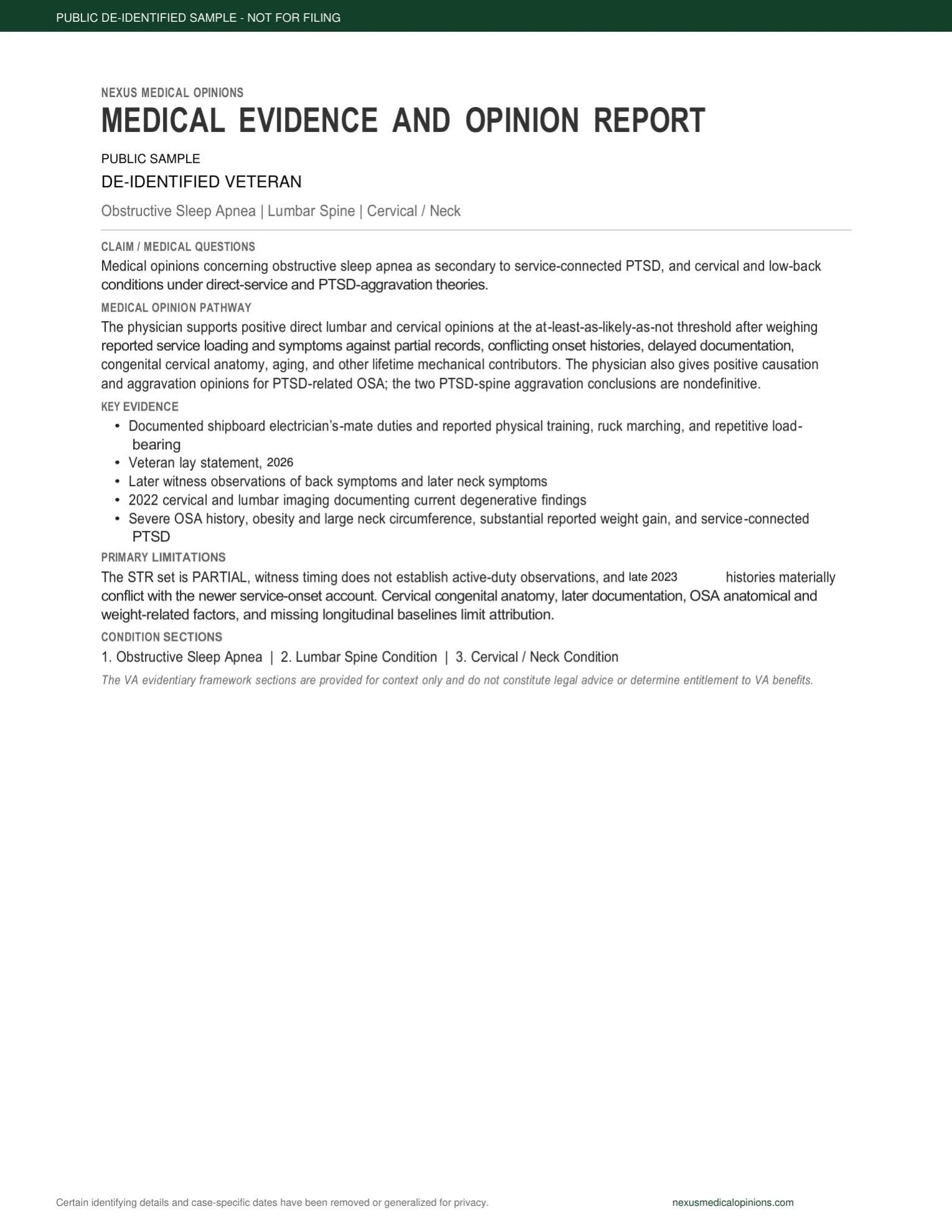
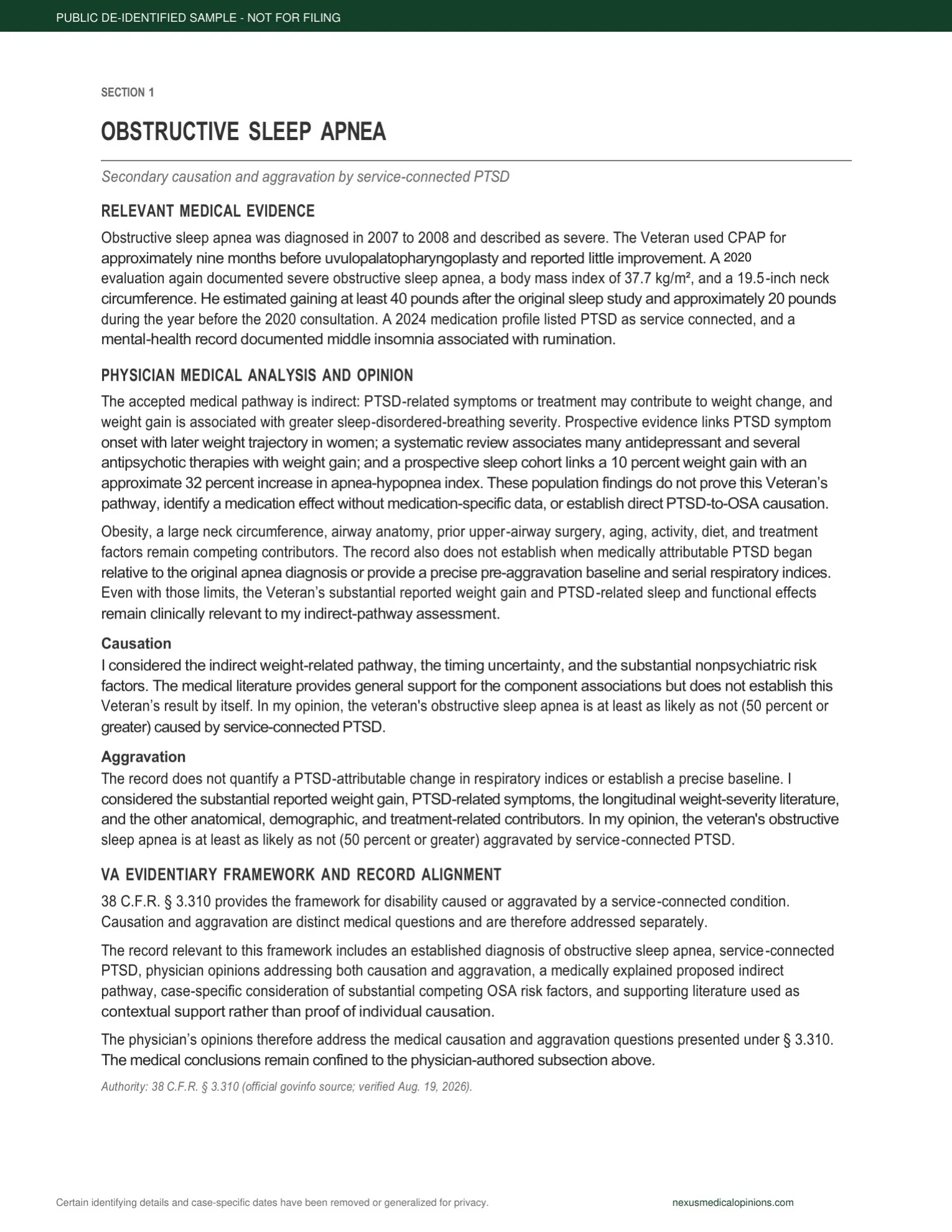
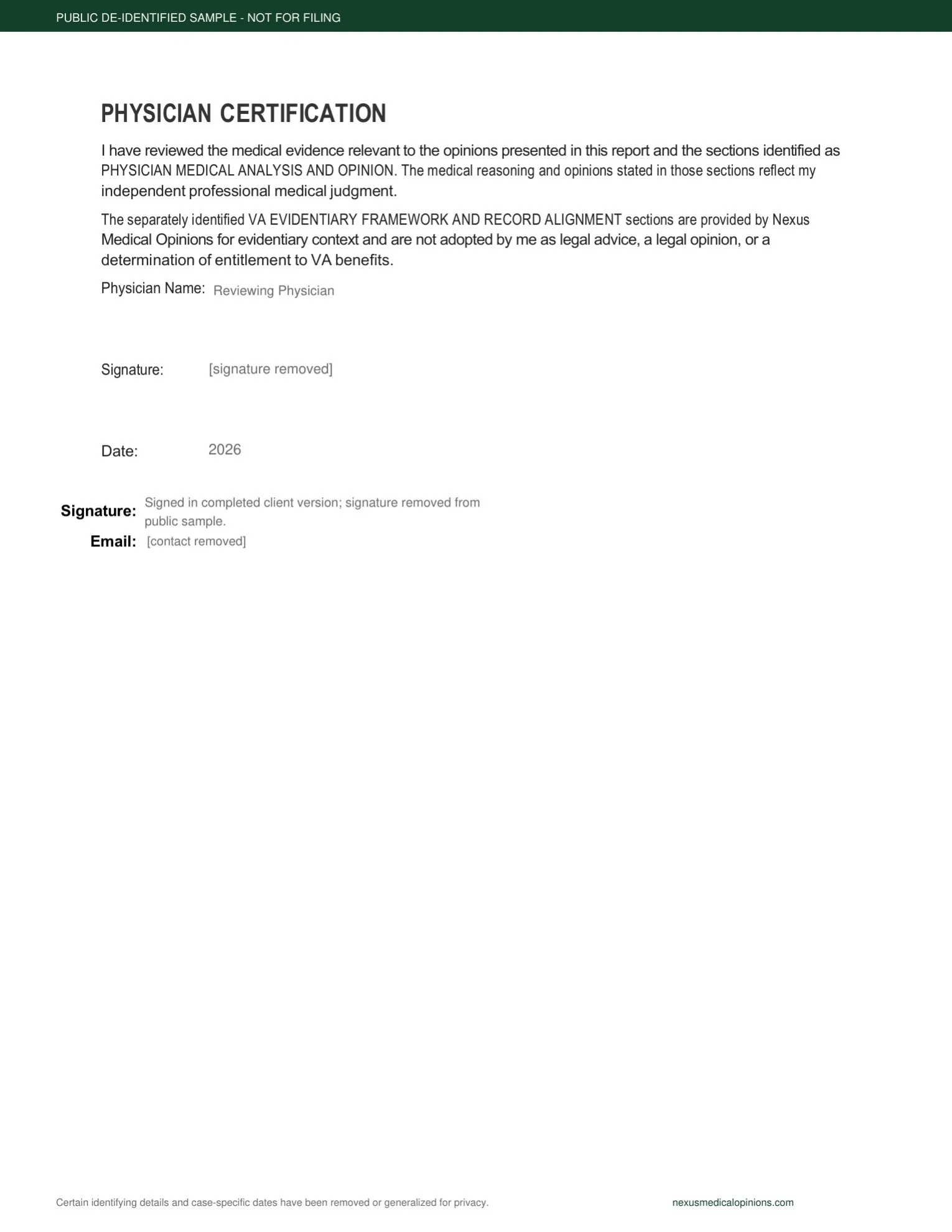
GENERALIZED STRUCTURAL PREVIEW
The report
More than a conclusion. A medical opinion that shows the reasoning.
A Nexus Comprehensive Medical Opinion Report brings the medical record, chronology, relevant literature, competing evidence, and condition-specific analysis together so the physician's opinion can be followed from evidence to conclusion.
REVIEWED
Not a template letter
The opinion should explain why.
A short nexus letter may state a diagnosis, summarize a few records, and provide a favorable or unfavorable conclusion. Complex VA medical questions often require more.
Nexus is designed around a comprehensive report that shows what was reviewed, identifies the medical question, addresses relevant evidence, considers competing explanations, incorporates appropriate medical literature, and explains the reasoning behind the physician's opinion.
- Diagnosis
- Limited record summary
- Medical conclusion
- Brief rationale
- Defined medical questions
- Broader record review
- Medical chronology
- Favorable and unfavorable evidence
- Relevant literature
- Competing explanations
- Condition-specific analysis
- Physician medical opinions
- References
The foundation
The opinion starts with the record.
The report identifies the materials reviewed so the reader can understand the evidentiary basis of the analysis. Potential sources may include service, treatment, examination, imaging, testing, medication, opinion, lay, and relevant case materials.
Listing a record does not mean every document supports the requested conclusion. The purpose is to establish what evidence was actually considered.
Define the question
A strong opinion answers a specific medical question.
Each issue should identify the medical relationship being evaluated.
Is the current condition medically related to military service?
Did a service-connected condition cause another medical condition?
Did a service-connected condition increase the severity of another condition beyond its expected course?
How should competing risk factors, chronology, medications, other conditions, and alternative explanations be evaluated?
Put the record in time
Chronology can change the medical analysis.
The timing of symptoms, diagnoses, injuries, treatment, medication changes, imaging findings, exposures, and other medical events may be central to determining whether a proposed relationship is medically supportable.
- 01Service
- 02Reported symptoms
- 03Medical evaluation
- 04Diagnosis
- 05Treatment
- 06Later examination
Sequence informs context. It does not determine the conclusion by itself.
Favorable and unfavorable evidence
A credible medical opinion has to address more than the evidence supporting one answer.
The report should consider evidence supporting the proposed relationship as well as conflicting histories, unfavorable examinations, competing risk factors, alternative causes, gaps in chronology, and limitations in the available record.
The goal is not to force the evidence toward a predetermined result. The goal is to explain what the medical record can support.
Research in context
Medical literature can support the reasoning without replacing the individual record.
Relevant peer-reviewed research may help explain disease mechanisms, risk factors, medication effects, occupational exposures, secondary relationships, or competing medical explanations.
Population-level evidence does not automatically establish causation in an individual veteran. The literature has to be applied in the context of that veteran's own medical history.
The Nexus approach
Separate medical questions can still belong to one medical history.
A veteran may have several conditions involving overlapping symptoms, medications, risk factors, service history, and medical evidence. Reviewing those relationships together can provide context that is lost when each issue is treated as an isolated template.
Each question stands on its own
Integrated does not mean every condition gets the same answer.
Each medical question is evaluated independently. The evidence may support one relationship, fail to support another, or be insufficient to reach a reliable conclusion.
A comprehensive report can still reach different conclusions for different conditions because each opinion must reflect the evidence relevant to that specific medical question.
Conclusion determined by the record
The conclusion
The opinion comes after the analysis.
The report clearly states the physician's medical conclusion for each question. The reader can see the question, the evidence considered, and the reasoning that precedes the opinion.
Independent medical judgment
The physician determines the final medical opinion.
The physician reviews the relevant medical evidence, analysis, and proposed opinions and determines whether to adopt, revise, or decline the conclusions based on independent medical judgment.
The final report must reflect the physician's own medical opinion.Report structure
Built so the reasoning can be followed.
- 01Case identification
- 02Records reviewed
- 03Scope and medical framework
- 04Medical question
- 05Relevant medical history and chronology
- 06Lay evidence when relevant
- 07Favorable and adverse evidence
- 08Relevant medical literature
- 09Competing medical explanations
- 10Condition-specific medical analysis
- 11Physician medical opinion
- 12References
- 13Physician certification and signature
Report structure may vary depending on the medical questions and evidence in the case.
GENERALIZED CONTENTS PREVIEW
Report structure
De-Identified Sample
Review an actual Nexus report.
This de-identified sample is based on a completed Nexus medical opinion report. Identifying information and physician signature details have been removed for privacy. It shows how the medical evidence, relevant literature, competing considerations, condition-specific analysis, evidentiary context, and physician certification are presented in the completed work product.
Report pricing
One comprehensive report. Up to five medical issues.
Start with the medical evidence
Build the opinion from the record, not from a template.
Start your medical review or request a sample report to see how Nexus approaches complex VA medical questions.